
Production Agentic System Patterns — The Complete Series Map
Every module, every pattern, and the exact trajectory to close the gap between scattered AI knowledge and production-grade engineering.

I used to feel like I knew agents.
I’d read the papers. I followed the right people on Twitter. I watched the talks. I could explain ReAct, chain-of-thought, RAG, tool calling — any of it, on demand. When a new concept dropped, I’d add it to my mental inventory and move on.
Then I sat down to engineer a real system — a production agent that had to be reliable, observable, safe, and maintainable — and I had nothing. Not because I lacked concepts. I had too many, with no map connecting them. No structure to tell me which pattern to reach for, when to stop, or why things were breaking the way they were.
That moment is what this series is about.
What this series is not
This is not a beginner’s guide to large language models.
It assumes you have already built something with agents. You know what a prompt is, what RAG does, what tool calling looks like. You may have shipped a prototype that worked beautifully on your laptop and then quietly fell apart in production.
If that sounds familiar, this is for you.
The one thesis that runs through everything
An LLM is a brilliant, fallible, manipulable proposer. Production engineering is the discipline of wrapping it in structure, feedback, memory, and deterministic guarantees — so the system is reliable, safe, and improvable even though the model at its core is none of those things on its own.
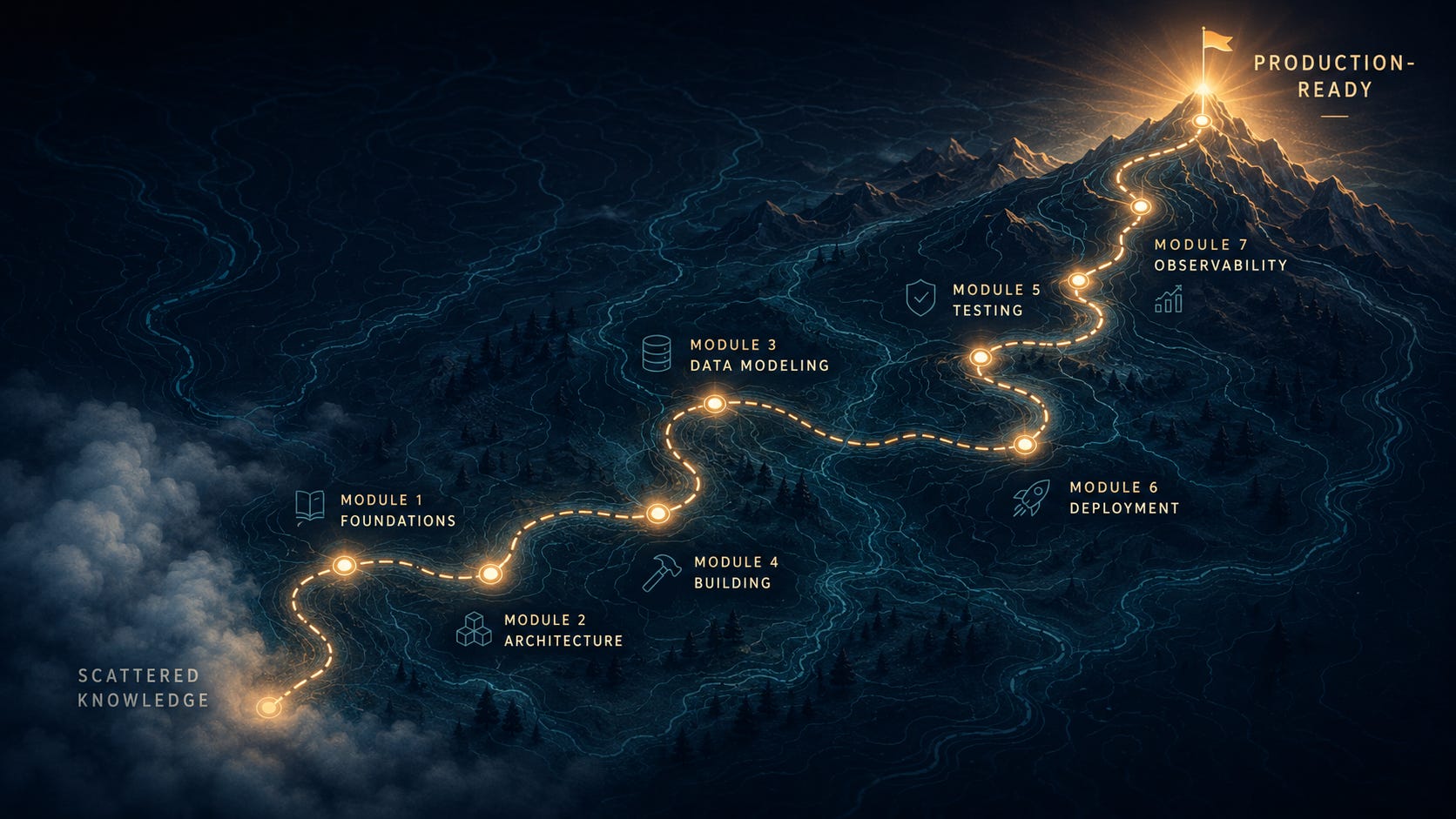
That single sentence is the architecture of this entire series. Every module is one more layer of the wrapper. Every pattern solves one specific failure that appears when that wrapper is missing.
How every module is built
Each article in this series follows the same spine — deliberately:
Problem first → why it bites in production → the pattern → code → real use case → when NOT to use it.
You learn the failure before the fix. That’s intentional. The skill that transfers to real engineering isn’t knowing pattern names — it’s being able to name a failure you’ve never seen before and reach for the minimum pattern that resolves it.
All code follows two rules: every function is five lines or fewer, and code is written high-level to low-level, threading a single state object down from orchestration to processing. The top function reads like the algorithm. You only descend into the how as far as you need.
The full trajectory — read in order, or jump to your gap
Part I — Foundations (M0)
M0 — Foundations
The failure modes are architectural, not model-quality. An LLM is a CPU; an agent is a process; a framework is an OS. The problem-first method. And the trap that kills more systems than any bug: over-architecting.
Read this before anything else.
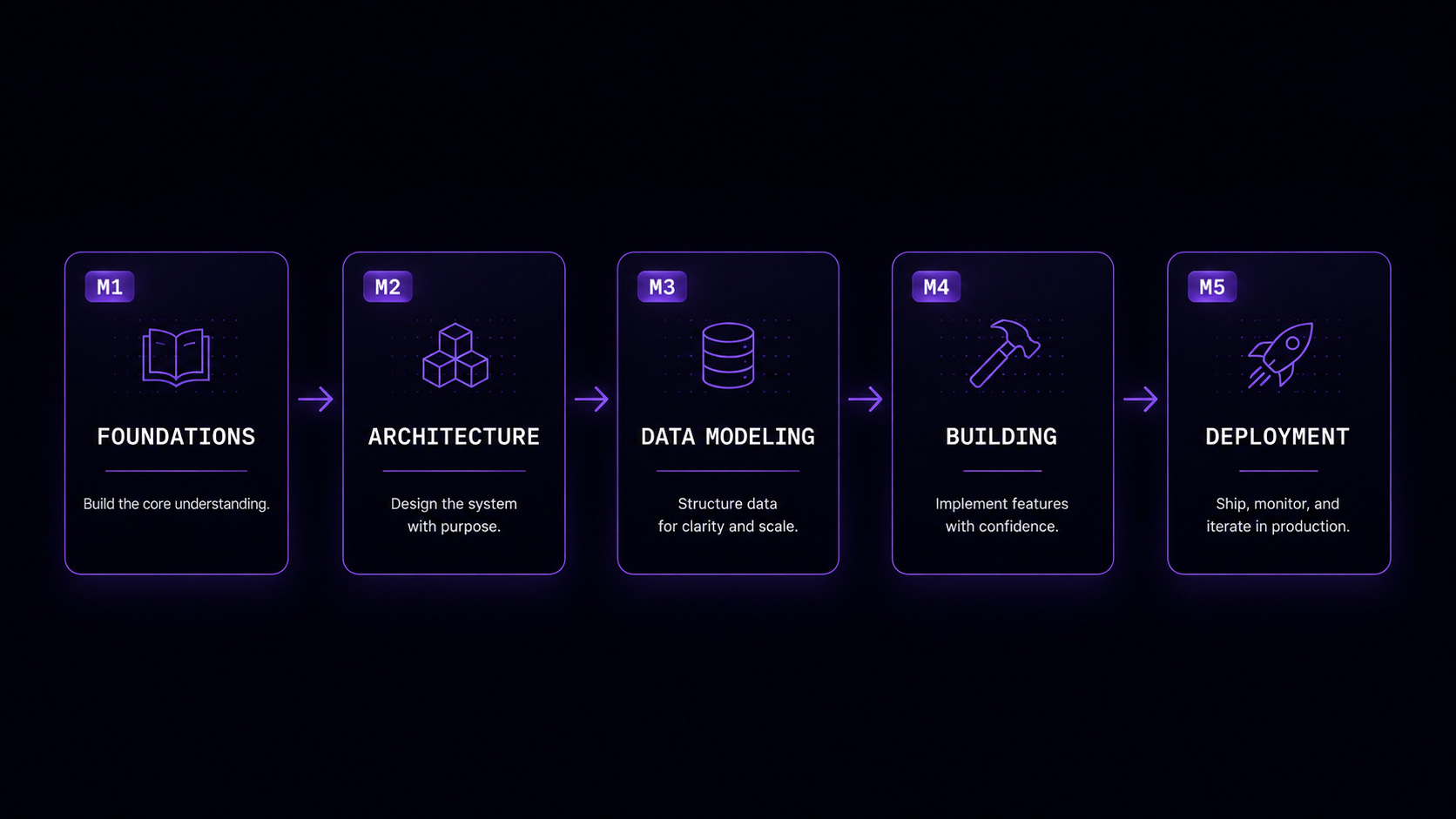
Part II — Core Reasoning Patterns (M1–M5)
These are the five atomic patterns. Everything in orchestration, memory, and production ops is composed from them.
M1 — ReAct The base reason→act→observe loop. How to close the open loop. Why you must always bound it.
M2 — Tool Use Grounding: if correctness matters, the LLM must not compute it. Tools are the hard guarantee.
M3 — Reflection Generate→critique→revise. This is risk reduction, not intelligence amplification. Know the difference.
M4 — Planning The explicit plan object. How to reduce entropy before a long task begins. The rule: no long task without a plan.
M5 — Evaluator-Optimizer Separate the maker from the checker. This is the seed of your eval infrastructure.
Part III — Orchestration (M6–M7)
M6 — Orchestrator Four coordination patterns: sequential, orchestrator-worker, fan-out, and handoff. Important note: a single agent wins approximately 64% of the time. The module teaches you to recognize that 64% before you reach for multi-agent complexity.
M7 — Routing & Supervisor Classify then dispatch. How to match cost to complexity. The hidden failure: misrouting is invisible — your system silently sends every request to the wrong handler.
Part IV — Context & Memory (M8–M9)
M8 — Context Engineering The context window is RAM, not storage. The four corruptions that destroy agent behavior: poisoning, distraction, confusion, and clash. How to engineer the window deliberately.
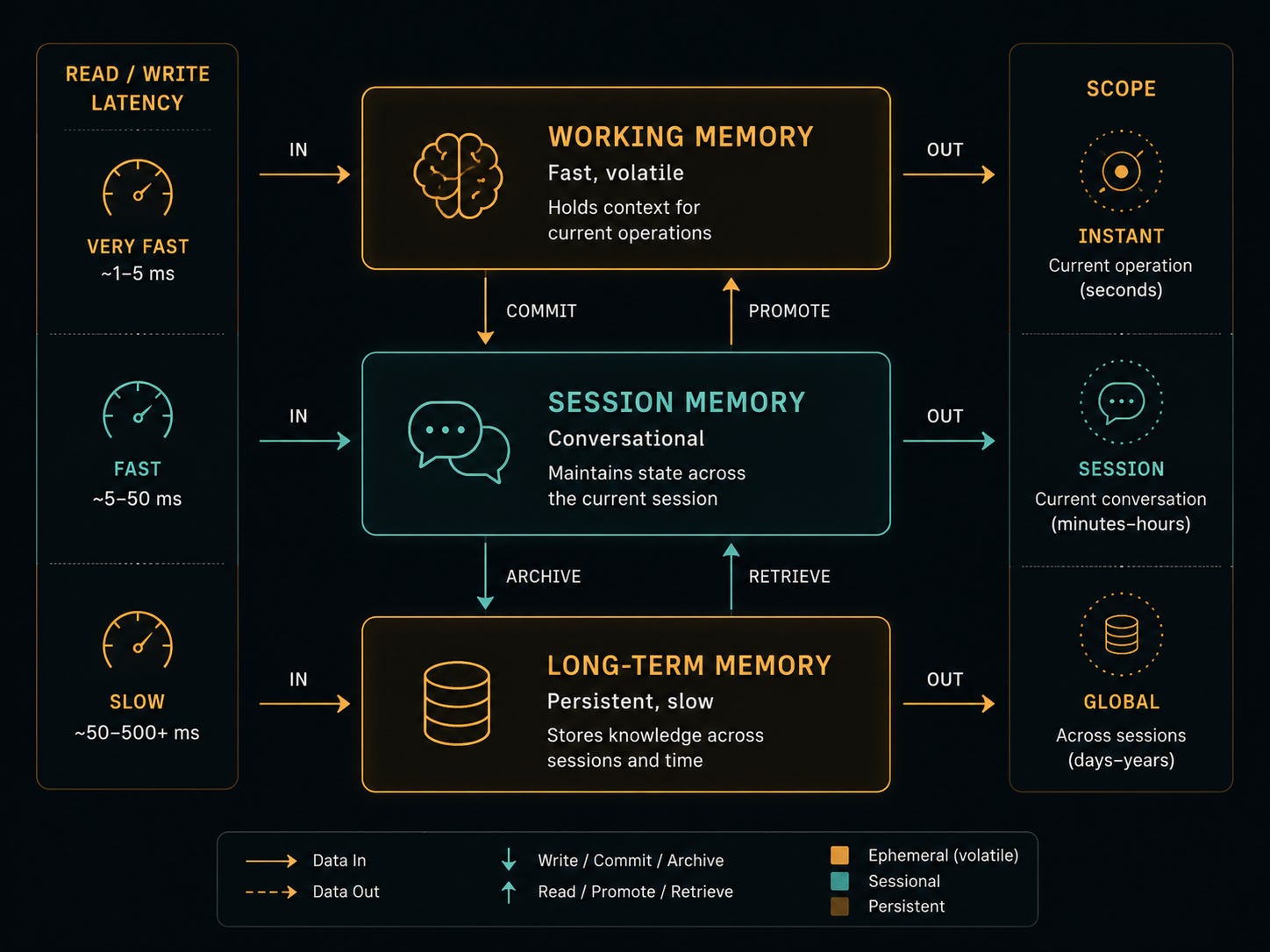
M9 — Tiered Memory Working memory, session memory, long-term memory. The key question for every write: is this relevant in 30 days? How to scope writes and — critically — how to build the invalidation path before you need it.
Part V — Production Stack & Ops (M10–M13)
M10 — Reliability Patterns Stop conditions, checkpointing, retry with backoff, fallback chains, and human-in-the-loop. How to build an agent that fails gracefully instead of silently.
M11 — Guardrails & Security Defense-in-depth at every boundary. Indirect prompt injection. The Layer-3 code boundary that must be a hard wall, not a suggestion.
M12 — Observability & Eval Trace every run. Eval is a first-class, continuous component — not a test suite you run once before shipping. The compounding feedback loop that makes every iteration better than the last.
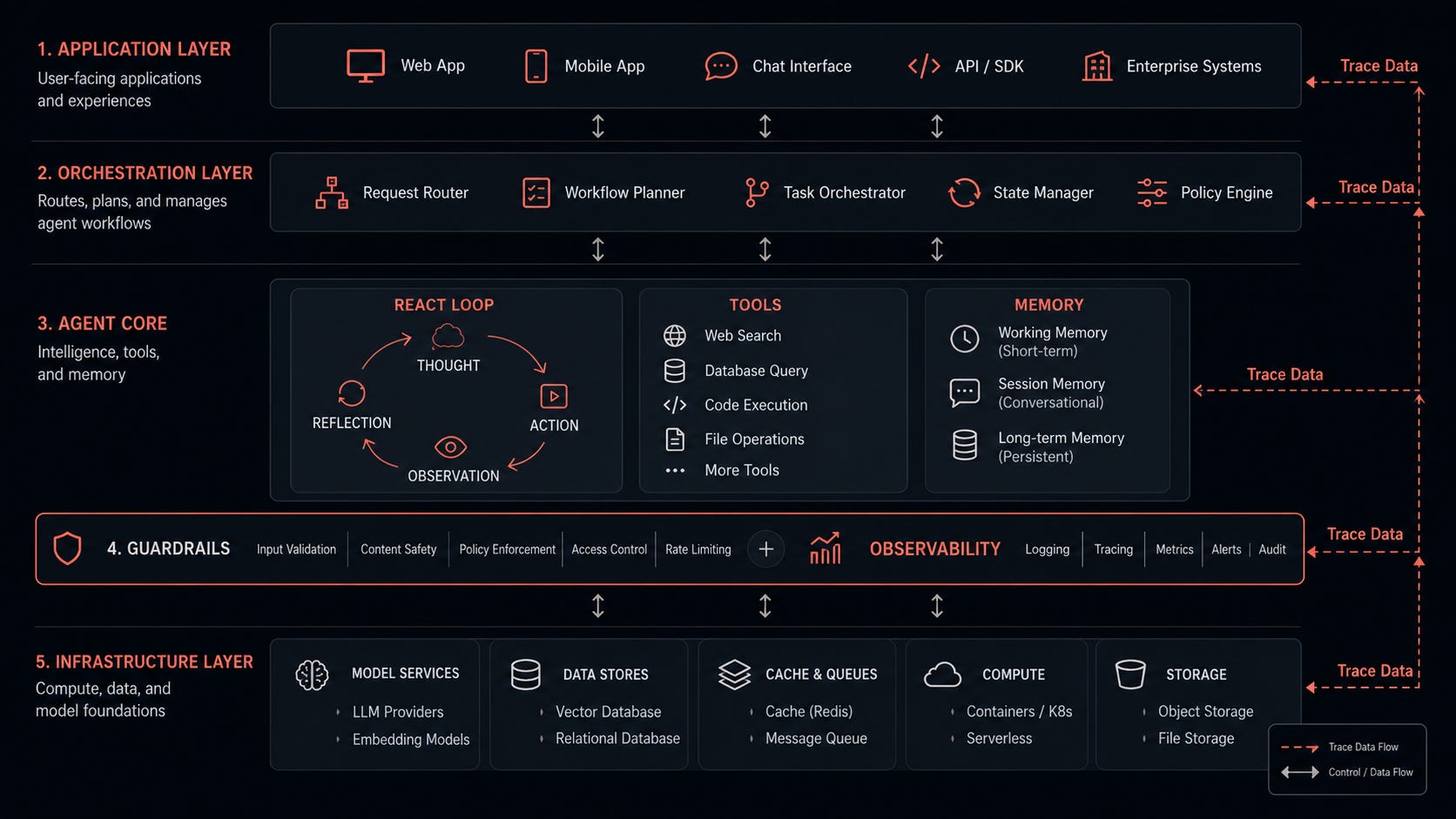
M13 — The Reference Stack Wire it all together. Clean layering beats framework choice. How real engineers grow an architecture from observed failures — not from whitepapers.
Part Two — Advanced & Deep Patterns
Once Part One is solid, three new pressures appear at scale. Part Two is about those pressures.
The Part Two thesis: Advanced agent engineering is mostly distributed-systems engineering with an LLM in the loop.
Frontier A — Multi-Agent Communication
How agents communicate without a conductor. Message passing, blackboard patterns, pub-sub. Why ordering is the silent killer.
Frontier B — Determinism, Economics & Performance
Semantic caching. Deterministic replay. Cost as a first-class architectural property — not an afterthought.
Frontier C — Skills, Permissions & Environment
Capability manifests. Minimal, just-in-time permissions. MicroVM isolation. The principle of concentric containment: every layer assumes the one inside it is compromised.
Frontier D — Self-Improvement & Advanced Memory
Reflexion. Episodic, semantic, and procedural memory taxonomy. The one rule that doesn’t change as models improve: the agent never edits its own safety controls.
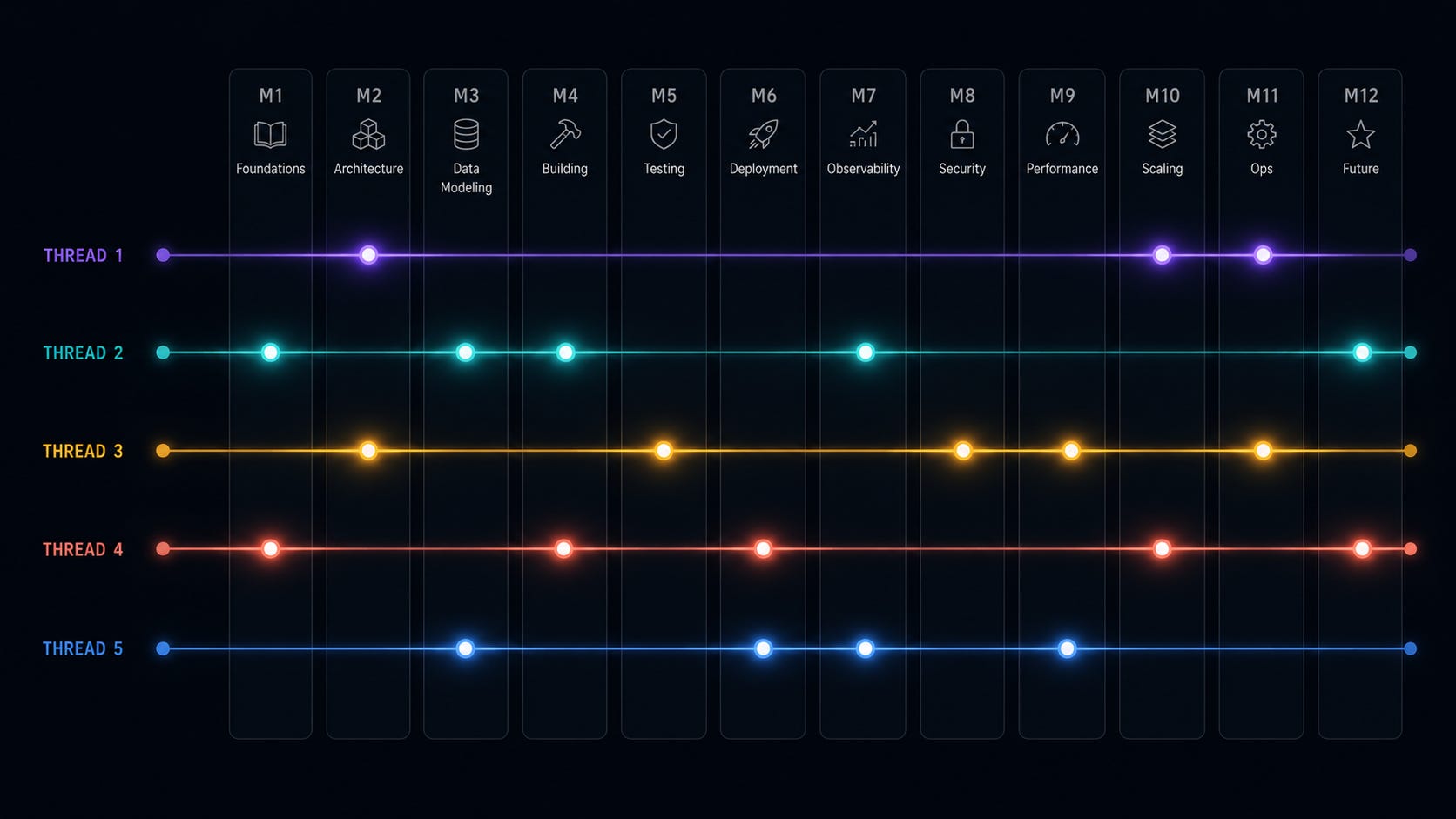
The five threads that run through everything
These are the patterns within the patterns. Spotting them is the difference between reading a glossary and developing an engineering instinct.
1. Code guarantees; the model proposes. This appears as a reasoning rule in M2, a reliability rule in M10, and a security rule in M11. Same principle, three faces.
2. Make the important thing an explicit object and re-inject it. The plan in M4, the pinned intent in M8, the scoped memory in M9. The fix for “the model loses the thread” is never a bigger context window.
3. The state object is the trace. The scratch you thread through every loop is your observability layer. You build it for free as you build the agent.
4. Proportionality — don’t over-architect. Stated in M0, enforced in M6, M9, M10, M11, and M12. The minimum structure that correctly serves the actual risk.
5. Patterns compose. Planning calls ReAct (M4 ← M1). Reflection is ReAct turned inward (M3). Evaluator-optimizer grows into continuous eval (M5 → M12). The reference stack is all of them layered (M13).
How to use this series
Reading the full course: Go M0 → M13 in order. Do not skip the “when NOT to use it” sections. They carry half the lesson. After Part One, take the exam closed-book, run the solution, and grade yourself. If you reached for a heavier pattern than the question needed, re-read M0 and M6.
Jumping to your gap: Use the module descriptions above to locate your specific failure. If your agent loses context on long tasks, go to M8. If it’s not observable, go to M12. If it sometimes loops forever, go to M1 and M10. Each module is self-contained enough to read on its own.
On the job: Start with one agent, good tools, and a trace. Add the one pattern that fixes your observed failure. Prove it with eval. Harden with stakes. That loop is the whole course applied.
What comes next
Each article in this series follows the map above — one module, one pattern, one real production failure, and the exact code that resolves it.
The next article covers M0 — Foundations: why production agent failures are architectural by nature, and why the most dangerous thing you can do when starting a new agent system is to reach for a framework before you understand the failure modes.
If this series is solving a problem you’ve felt before, follow me here — I’ll be publishing each module in order. Drop a comment below: which module are you most curious about? Your answer helps me know which failures resonate most with engineers right now.
And if you want to know the moment a new article drops — hit the email follow button. No noise, just the next module when it’s ready.